PM Network Online
e-Project Management for the New Reality
by Peter Kulik and Robert Samuelsen
A well-known study by McKinsey and Company
found that high-tech projects completed on time but up to 50 percent over
budget were nearly 25 percent more profitable than projects completed six
months late but on budget. [This study is cited in a number of public sources:
for example, http://www.pivotint.com/index.html;
http://www.processgroup.com/cycletime.htm;
http://www.leapworks.com/frameworks/glfpd/overview.html]
Today’s e-business environment has amplified this finding, moving at the
incredibly fast pace of what has been called “Internet time.” This pace is
driven by market conditions and the speed at which new technology has evolved.
Time compression creates unique challenges for project managers and, while many
have been tempted to discard project management in the new environment, project
management has become even more important.
Readers of PM Network are familiar with project tradeoffs of time, cost,
and quality, and the idea that it is impossible to maximize all dimensions simultaneously
because of the constraints inherent in each parameter. The nature of e-business
shifts e-project tradeoffs to focus on time with pressure for tradeoffs in
quality and cost to achieve aggressive cycle times.
Most e-projects differ from traditional software projects in two key
dimensions: the frequency of releases is higher; the scope of what is deployed
in each release is smaller. While major e-services redesign or redeployment
(for example, Wal-Mart’s recent deployment of a new e-store) are similar in
many ways to traditional software projects, the modularity and (mostly) common
GUI lends itself to incremental updates over time. These incremental
updates—new features, new content, and fixes—have unique attributes that demand
project managers take a different approach to remain relevant.
The differences between e-projects and traditional projects suggest a process
and framework for e-project management that adapts proven project management
rigor for use in the fast-paced, time-crazed new economy.
Project Characteristics
For the purposes of this article, an e-project is any project that
involves creating or changing source code that is deployed on the Internet.
This includes a range of projects from new content deployment in HTML to applet
enhancements in Java and ActiveX. As shown in Exhibit 1, most e-projects are
distinctly different from traditional projects along two key axes: release
frequency and software size. Traditional projects are typically six months or
longer in duration and include development of more software, whether measured
in lines of code, function points, use cases, web pages, or other measures.
Most e-projects are typically shorter—from days to a few months—and are much
smaller than traditional projects.
Some key attributes of e-projects:
- E-projects are iterative by nature—multiple
iterations are the rule and users expect them. Incremental new features
can be introduced—and bugs fixed—in real time.
- Speed is of the utmost importance in e-projects.
Typically it makes business sense to trade off scope, cost, and/or quality
to accelerate the speed of project completion.
There are typically three “classes” of e-projects: new construction, remodeling, and maintenance—not unlike building a house. In almost all cases, they are measured in months, weeks, and days, respectively. The time frame of “years” is not in the vocabulary for e-projects!
Software Project Management Map
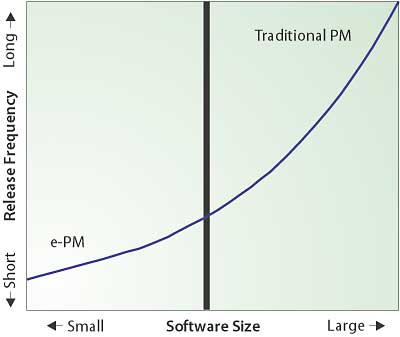
Exhibit 1. Traditional project management is highly evolved to deliver large software projects with relatively long release frequencies; the realm of e-Project Management is small software projects with short release frequencies.
New Construction. This class represents the initial build of an
e-project, and falls in the area to the right of the vertical line in the
software project management map in Exhibit 1. Just like a new house,
cost/benefit analysis, blueprints, approvals (such as building permits),
contracts, and legalities are essential steps. It may take months to complete
the initial implementation of an e-project. To develop a new online store or a
business-to-business exchange might take months.
Remodeling. New feature introductions are typical of remodeling
e-projects, which fall in the “e-PM” zone in Exhibit 1. Just like a house,
whereby you continue to live in the house during the room addition, new feature
introductions are typically done while the online service continues to operate.
Due to the dynamic modularity of HTML, new features can be added with little
disruption and made available to users immediately. Typically, remodeling
projects take weeks to complete.
Maintenance. Every homeowner knows the need for constant maintenance.
E-systems are no different, with maintenance performed in real time.
Maintenance can include bug fixes, minor enhancements, content changes and
additions, and other mundane tasks. Deployment of maintenance projects can
occur one or more times a day.
As an Internet site or service evolves, remodeling iterations may dramatically
transform it over time.
A summary comparison of traditional and e-projects is shown in Exhibit 2.
Comparison of Traditional and e-Projects
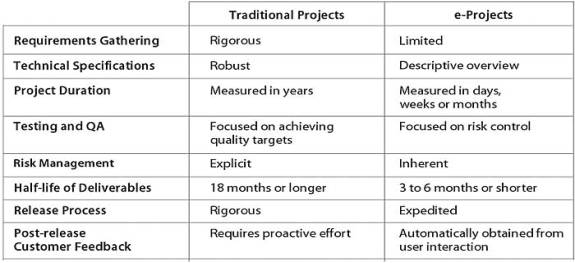
Exhibit 2. The differences between traditional
software projects and e-projects drive a
different approach for e-project management.
Process Challenges
Perhaps the biggest challenge in
an organization and its e-projects is the “apparent” abandonment of internal
processes. Traditional product realization processes have been built over many
years and often reflect the culture and hierarchy of the organization. Each
step in the process is measured against existing standards prior to advancing
to the next step. The traditional “waterfall” process model is focused on
quality and cost concerns, with less regard for time. Breaking this paradigm is
uncomfortable and unpopular in highly structured organizations.
Nevertheless, the overriding importance of time drives modifications in
existing processes, evidenced by the proposal of “light” methodologies by
several industry sources. Seven or eight process steps must be reduced to three
or four. Five or six layers of signature signoff must be reduced to one, two,
or three. While some Internet pundits may claim a complete abandonment of
process, we believe there is still a need for process—perhaps more than ever
before—to maintain control over the e-business technical infrastructure.
However, processes must adapt to the focus on speed, allowing for employee
empowerment and organizational creativity.
In fact, there may be three different processes: one for new construction, one
for remodeling, and one for maintenance.
“4D” e-Process for New Construction
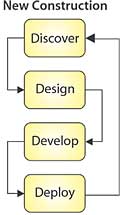
Exhibit 3. This graphic depicts a high-level process model for new construction e-projects.
New Construction. New construction should follow an accelerated
implementation of existing software development processes or adaptations
thereof. For example, a simple four-step process for new construction might be
such as found in Exhibit 3.
In this “4D” e-process the discover phase is focused on the business analysis
of the project. The design phase is used to create requirement documents,
technical specifications, and acceptance criteria. Obviously, the develop phase
is for programming, graphic design, technical implementation, and quality
assurance. The deploy phase includes marketing activities and other
post-release activities such as customer service, operations, and fulfillment.
e-Process for Remodeling
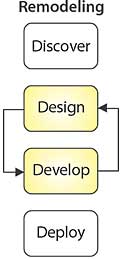
Exhibit 4. The high-level process model can be simplified for remodeling e-projects to support rapid turnaround.
Remodeling. The remodeling process will be an accelerated
implementation of the new construction process with the focus on iterative
design and develop phases. Usually discovery and deployment issues are
associated with the whole project, not just new feature introductions, unless
the remodeling project directly impacts those phases.
The remodeling process is iterative, as illustrated in Exhibit 4. Remodeling
projects are ongoing and rapidly cycle through the design and develop phases.
Unlike new construction, these projects are not necessarily planned well in
advance but rather are part of an ongoing enhancement cycle.
This type of activity must be anticipated, allowing for flexible resource
allocation (financial and human resource) and rapid turnaround.
Micro-Release Template
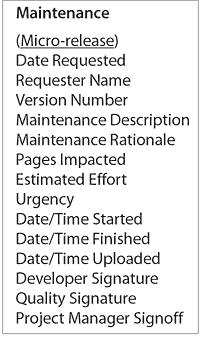
Exhibit 5. These data fields can be used to
create a simple template to track and
control micro-releases.
Maintenance. The maintenance process is empowered through a
microrelease process. If there are many “maintenance releases” a day, process rigor
must be streamlined to accommodate very fast execution of configuration
management. This iterative and dynamic process can be accomplished with a
single microrelease page, such as is shown in Exhibit 5, similar to what is in
use today by one of our clients. In this microrelease scenario, each
maintenance item is tracked through a series of one-page forms, kept in a
notebook, and logged with other project deliverables. And just as the process
is rigorous, resources need to be organized to accommodate these types of
changes.
e-Project Management
Releasing new features ahead of competitor websites can increase traffic,
improve visit “stickiness,” and increase return visits. All of these can drive
increased transaction and advertising revenue, providing a company can stay
ahead of and differentiate itself from fast-moving competition.
Schedule management, scope management, quality management, and release
management are key aspects of project management for e-projects.
Schedule management of e-projects with real-time deliverables involves a
balance between planning and the complexity of work to be done.
Schedule planning and management for major releases should be comprehensive,
can often be streamlined significantly for feature releases, and may be nonexistent
for microreleases. If schedule planning and management is benchmarked at 10–20
percent of total project effort, for a three-month major release, schedule
planning and management should be on the order of one to two weeks. Schedule
planning and management should not take more than one to two days for a
two-week feature release.
Closely tied to schedule management is scope management. Scope must be
managed so that the schedule can be achieved. This can involve ruthlessly
managing scope creep—moving new features out and managing microreleases. As
discussed below under release management, regular release cycles can
significantly aid in managing scope by providing a foundation for
feature-function phased introduction.
In traditional software development, quality management involves
ensuring adequate testing and defect density below targets to minimize the
likelihood of customer-discovered bugs. E-project quality management has a
similar objective with the advantage of daily (or even multiple daily) releases
possible to correct faults in “released” software and real-time feedback from
website users identifying faults. To accelerate time to market, an e-project
can take advantage of the Internet environment to make risk-based decisions,
eliminating just the most serious faults, ensuring that the integrity of the
site (much of which can be done using automated tools) and completing
additional testing and fault repair in real-time on the live site, leveraging
users as testers.
Release management in e-projects is a critical area for e-project
management. Traditional software projects (and new construction e-projects)
typically have releases once every six to 12 months or more, depending on the
nature of the software being released. Traditional software releases usually
involves burning CDs, documentation updates, packaging, and distribution,
making it costly to release more often. In some cases, software patches can be
released on a weekly or monthly basis depending on the severity of the faults
they fix.
E-projects, on the other hand, can have daily releases, or even multiple daily
releases. To maintain control, sites such as Microsoft, MSNBC, Compaq, Cisco,
and others indicate the dates and times of the latest updates directly on the
web page. These may change daily or on a minute-by-minute basis for news
services. Delta-Air, for instance, shows a version number in its HTML source
code, and Merant actually shows recent maintenance releases in its HTML source
code.
Recent failures at well-established sites such as Amazon.com and E-Trade
highlight situations in which controlling e-project release cycles becomes
critical to maintaining the integrity of the site or service. Yet the browser
GUI hides complexity that can make configuration management more complex by an
order of magnitude or more. For example, this complexity can include applets in
Java for Netscape users and Active/X for Internet Explorer users, HTML source
that varies for different browsers to optimize the user interface, and audio
and video formats for different multimedia players.
Distribution costs and efforts for Internet-deployed software are very low
because there are no CDs to burn, no user manuals to print, no packaging to
complete. Resulting from this “ease of software update” phenomenon is the
temptation to release fixes quickly and frequently. However, the growing
complexity of websites and services can make it difficult to “back out”
fault-causing changes. Frequent software updates need to be expedited through
procedures that allow them to be managed and controlled carefully, and the
three classes of releases need to be mapped into planned release cycles.
Managing an e-project can be an exhilarating experience for a project manager
if there is unified support and cooperation. Learning to adapt existing rigor
to an e-project will cause you to reevaluate traditional ways of project
implementation. Some good points to consider are:
- Streamline—don’t abandon—processes.
- Make a living plan for the next two or three
iterations.
- Add structure to accommodate iterative release cycle
processes.
- Fit planning effort to around 10–20 percent of
projected project effort.
- Plan testing based on risk.
- Use automated tools for testing and site integrity.
- Implement time-based metrics such as cycle time.
A good e-project is not absent of project management. Rather, a different type of rigor is required. Recognizing the importance of speed, maintaining good configuration management, and managing iterative release cycles will help you be successful in your e-projects.
Peter Kulik is an independent consultant with more than 15 years
industry experience. He is based in Dayton, Ohio, USA, and is co-founder of
KLCI, specializing in software project management, metrics, and business
development. He is also a long-standing member of PMI®.
Robert Samuelsen is an independent consultant with more than 16 years of
industry experience. He is based in Ithaca, N.Y., USA, and is founder of
Samuelsen eCommerce Enterprises LLC, specializing in e-business practices. He
was formerly worldwide director of Internet Banking at NCR Corp.